


AI Agents in HR: Strategic Roadmap for Enterprise Transformation
Strategic Frameworks, Role Evolution, and Implementation Realities (with Workday Case Study)
Executive Summary
The Opportunity: AI agents are transforming HR from administrative overhead into strategic advantage. Organizations report 50%+ reductions in time-to-hire, $5M+ annual savings in service delivery[6], and dramatic improvements in employee experience. But the transformation is more nuanced than "AI replaces HR jobs"—AI handles middle execution while humans remain essential for beginning (prompting) and end (verifying). This shift creates new bottlenecks and reveals massive latent demand for HR services previously suppressed by cost and capacity constraints.
Current State: 82% of organizations now use AI agents in operations[1], with deployment rates tripling from 11% to 33% in a single quarter[2]. Workday has invested over $1.1B in AI acquisitions (HiredScore, Paradox, Flowise, Sana) to become "the AI platform for managing people, money, and agents"[3]. We are in the early transition phase—analogous to 1900-1920 for electricity adoption—where competitive advantage accrues to early movers.
Key Insights:
Human is end-to-end, AI is middle-to-middle: New bottlenecks are prompt engineering and verification capacity, not execution speed. This elevates, not eliminates, the human role
Jevons Paradox applies: AI efficiency reveals latent demand rather than eliminating jobs (see: radiologists busier than ever despite AI diagnosis tools)
Technical debt creates work: 2-3 years of infrastructure refactoring required before AI delivers full value (documentation rewriting, data standardization, integration architecture)
Enterprise adoption works in evolution, not revolution: Realistic transformation timeline is 3-5 years, not 12 months[10]; respect organizational adaptation cycles
Key Risks:
56% of companies lack adequate AI governance policies[1]
Bias in AI-driven hiring remains documented concern requiring continuous auditing
Integration complexity and change management consistently underestimated by 2-3x
ROI depends heavily on data quality and organizational readiness—rushing without foundation fails
Critical Actions:
Start now—the advantage isn't just in having AI, but in the compounding benefits of the data, refined processes, and AI-fluent culture built during the early years—assets that are harder for laggards to replicate quickly.
Establish AI governance framework before scaling (bias audits, human-in-loop protocols, Agent System of Record[8][9])
Invest in technical debt refactoring (budget 5-10 FTE for 2-3 years to modernize documentation, data, integrations)
Build AI fluency across HR team (2-3 year skill development timeline[24][25])
Plan for revealed demand (as AI removes constraints, stakeholders will expect previously impossible capabilities)
Manage workforce transition humanely (reskilling, transition support, transparent communication[23])
Expect 12-18 months to value; build for 5-10 year horizon
Introduction
HR faces a fundamental challenge: do more with less while delivering personalized, instant service to a workforce that expects consumer-grade experiences. AI agents—autonomous systems that don't just analyze but act—offer a solution. Unlike earlier HR automation that followed rigid rules, modern AI agents learn patterns, converse naturally, and execute complex workflows with minimal supervision.
But the narrative that "AI will replace HR jobs" is both too simple and fundamentally misunderstands how technological transformation actually works. History shows that efficiency improvements rarely eliminate demand—instead, they reveal massive latent demand previously suppressed by cost and friction. The radiologists are busier than ever, despite AI that can diagnose diseases faster than humans. Why? Because cheaper scans revealed that we needed far more medical imaging than we could previously afford.
This white paper examines how AI agents are being deployed in HR today, Workday's strategic positioning, and a realistic roadmap for the next 5+ years. Our perspective is that of independent consultants (InteDao) providing both opportunities and cautionary analysis for enterprises, particularly those with Workday as their HCM core.
Two Key Frameworks Guide This Analysis:
1. Human is End-to-End, AI is Middle-to-Middle
AI excels at execution (the middle of workflows) but humans remain essential for articulation (beginning) and verification (end). The new bottlenecks aren't where we expected—they're prompt engineering capacity and verification capability. This has profound implications for workforce planning.
2. AI is the New Electricity
Dr. Andrew Ng's framing captures the moment: we're in the early transition phase of AI adoption, analogous to 1900-1920 for electricity. Competitive advantage accrues to organizations that adopt during this window, not those who wait until AI is ubiquitous. By 2035, having AI in HR will be table stakes—the question is whether you're shaping the transformation or playing catch-up.
Beyond these frameworks, we examine the Efficiency Paradox (Jevons Paradox)—why AI that makes work more efficient often reveals latent demand rather than eliminating jobs. This pattern suggests AI will transform HR roles rather than eliminate them.
Why Now? Three converging factors:
Generative AI breakthrough (2023-2025) enabling natural language interaction and content creation
Enterprise AI platforms maturing with robust security, governance, and integration
Workday's strategic shift to AI-first architecture through $1B+ in major acquisitions
Why Caution? AI in HR touches sensitive domains—hiring decisions, performance evaluation, personal data. Responsible implementation requires balancing innovation with fairness, transparency, and human judgment. Moreover, the transformation timeline is 3-5 years, not 12 months. Organizations attempting "revolutionary" rather than "evolutionary" adoption consistently face change fatigue, governance failures, and half-baked implementations.
What This White Paper Covers:
We begin by examining the current landscape of AI adoption in HR and concrete use cases already delivering value. We then analyze Workday's AI strategy and ecosystem positioning. The heart of the paper introduces two critical realities that most analyses miss: the end-to-end vs. middle-to-middle dynamic and why enterprise transformation operates on geological time despite technological acceleration. We explore why AI creates more work than it eliminates (through revealed demand and technical debt refactoring).
We present near-term, mid-term, and long-term predictions for AI adoption in HR, grounded in historical patterns and emerging evidence. Strategic recommendations provide actionable guidance for CIOs and CHROs navigating this transformation. We conclude with the electricity analogy: understanding why the window for competitive advantage is now (2025-2028), not later when AI becomes ubiquitous.
Our Perspective:
This is not a vendor pitch. We acknowledge Workday's significant AI investments while questioning whether integration of four major acquisitions can be executed smoothly. We highlight both remarkable successes (IBM's $5M savings) and the cautionary reality that most transformation programs struggle. We believe AI will profoundly reshape HR—but through evolution over years, not overnight revolution.
Note on Platform Focus: While the specific platform analysis focuses on Workday, the strategic frameworks, timelines, and recommendations are universally applicable. The principles of "middle-to-middle" automation and evolutionary adoption are agnostic of the underlying HCM system.
The winners will be organizations that combine aggressive technology adoption with thoughtful governance, realistic timelines, and humane workforce transition. The losers will be those paralyzed by fear or seduced by hype. Both extremes miss the nuanced reality: AI is transformative, inevitable, and manageable—if approached strategically.
Let's begin by examining where AI in HR stands today.
The Current Landscape: AI Adoption in HR
Rapid Market Adoption
AI in HR has moved from experimental to operational. Key indicators:
82% of organizations deploy some form of AI agents[1]
Deployment tripled (11% to 33%) in one quarter[2]
Primary use cases: Resume screening, chatbots, predictive analytics, content generation
Early adopters focused on high-volume, repetitive tasks—recruiting and employee service—where ROI is clearest. Success stories like IBM (94% inquiry auto-resolution, $5M annual savings[6]) have accelerated broader adoption.
Value Delivered
Efficiency Gains:
AI resume screening processes thousands of applications in minutes vs. days
Chatbots provide 24/7 instant responses to routine HR queries
Automation eliminates 40-50% of low-value administrative work
Experience Improvements:
Candidates: Real-time engagement, easy self-service scheduling
Employees: Instant answers, personalized learning recommendations
Managers: AI-generated insights and decision support
Better Decisions:
Predictive analytics identify attrition risk and performance patterns
AI detects pay equity issues continuously vs. annual audits
Data-driven talent matching improves quality-of-hire
Critical Challenges
Despite momentum, organizations face real obstacles:
Governance Gaps: Only 44% have policies to secure and govern AI agents[1]. Without frameworks, risks include:
Unchecked bias in hiring/promotion algorithms
Privacy violations from inappropriate data access
Unaudited AI decisions in sensitive domains
Data Quality: AI effectiveness depends on clean, integrated HR data. Many organizations struggle with:
Inconsistent job titles and org structures
Siloed data across ATS, HRIS, learning systems
Incomplete employee skill profiles
Change Resistance: Employees fear job displacement; managers distrust "black box" recommendations. Success requires:
Transparent communication about AI's role
Training on AI collaboration
Demonstrating AI augments rather than replaces humans
Bias and Fairness: AI can perpetuate historical biases in training data. Recent examples include resume screeners favoring certain demographics and promotion algorithms reflecting past inequities.
AI Use Cases Across the HR Lifecycle
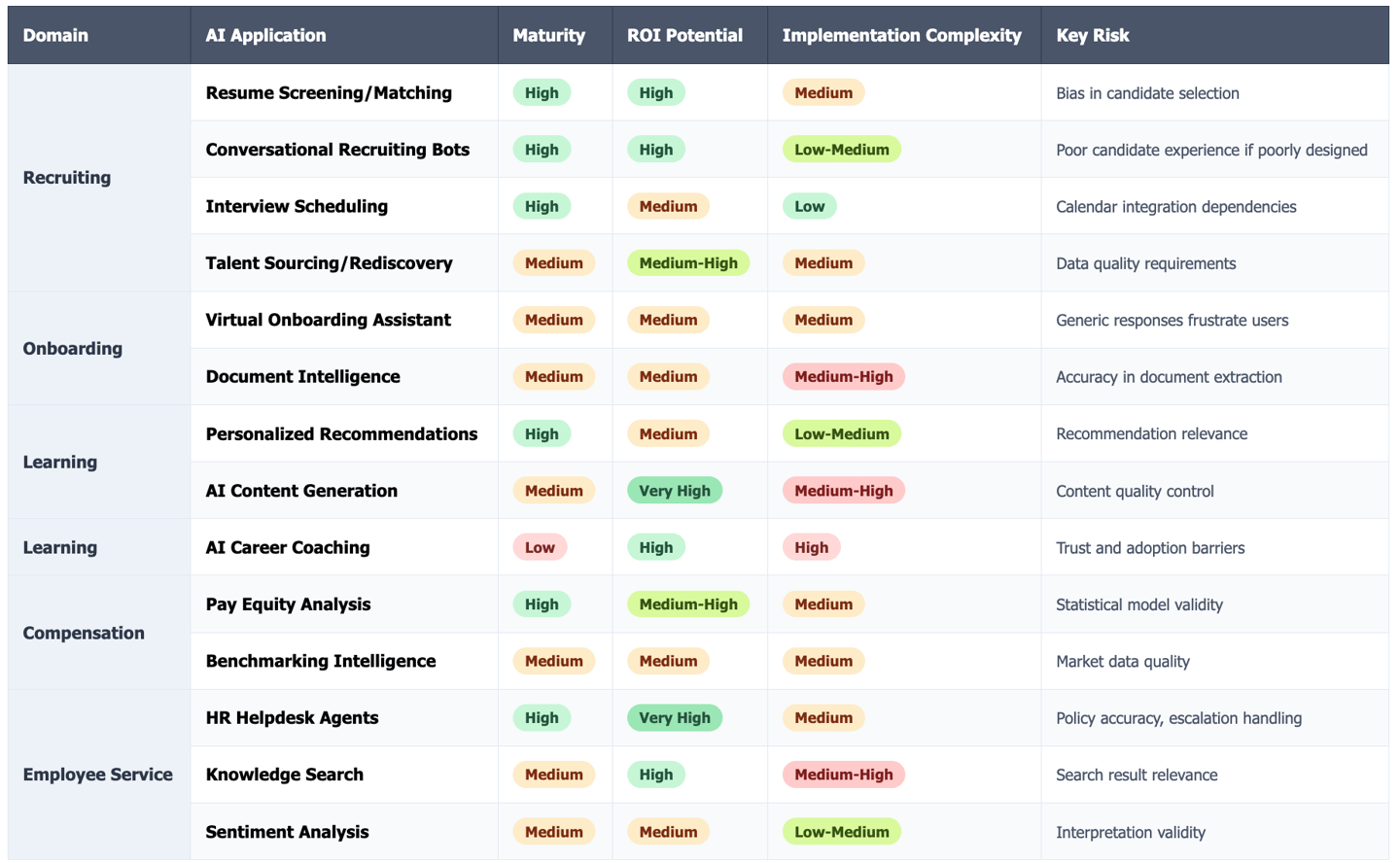
Deep Dive: High-Impact Use Cases
1. Talent Acquisition
AI Resume Screening & Matching
What it does: AI models parse and rank applications against job requirements, surfacing top candidates in seconds.
Business value:
Reduces screening time by 75-90%
Processes 10,000+ applications that would take recruiters weeks
Improves quality-of-hire by identifying non-obvious strong matches
Enables internal mobility by matching current employees to open roles
Workday integration: HiredScore acquisition provides native AI matching in Workday Recruiting[12]
Implementation considerations:
Requires clean job descriptions and qualification criteria
Must be monitored for bias (e.g., favoring certain schools, penalizing employment gaps)
Best practice: AI shortlists, humans make final decisions
Regular audits essential (quarterly bias testing recommended)
Metrics to track: Time-to-shortlist, quality-of-hire, candidate diversity metrics, recruiter hours saved
Conversational Recruiting Assistants
What it does: AI chatbots engage candidates 24/7 via web/text, answering FAQs, conducting basic screening, scheduling interviews.
Business value:
Candidate conversion rates exceed 70%[13]
Time-to-hire reduced to 3.5 days in high-volume hiring[14]
189M+ candidate conversations facilitated (Paradox case)[13]
Dramatically improved candidate experience (instant engagement vs. days-long waits)
Workday integration: Paradox "Olivia" acquisition brings conversational AI into Workday talent suite[15]
Implementation considerations:
Most effective for high-volume, structured roles (retail, hospitality, customer service)
Requires thoughtful conversation design (don't make it feel robotic)
Must have clear escalation path to human recruiters
Integration with calendar systems critical for scheduling
Metrics to track: Candidate engagement rate, time-to-schedule, drop-off rates, candidate satisfaction scores
2. Learning & Development
AI-Generated Learning Content
What it does: Generative AI creates full training courses from raw materials (documents, videos, expert interviews), including quizzes and summaries.
Business value:
Course development time: 4 months → 4 days[16]
Learning engagement increases 3x+ with personalized, interactive content[17]
Enables rapid knowledge transfer (new product training in days vs. months)
Democratizes instructional design (subject matter experts can create courses)
Workday integration: Sana Labs acquisition ($1.1B) brings AI content generation to Workday Learning[4]
Implementation considerations:
Requires subject matter expert review before deployment
Works best with structured source material
Quality control essential (AI can generate plausible but incorrect content)
Consider copyright issues when using external sources
Metrics to track: Course development time, learner engagement, knowledge retention, training cost per employee
Cautionary note: Early implementations show variable content quality. Human review remains non-negotiable.
3. Employee Experience & Service Delivery
HR Helpdesk AI Agents
What it does: AI auto-classifies, routes, and often auto-resolves employee HR inquiries without human intervention.
Business value:
IBM case: 94% auto-resolution rate, $5M annual savings, 50,000 employee hours freed[6]
Response time: Days/hours → seconds
HR staff focus on complex, high-value cases requiring human judgment
Consistent, accurate policy interpretation
Workday integration: Workday Case Management evolving with AI Case Agent[20]; Sana enables enterprise-wide knowledge search[18]
Implementation considerations:
Requires comprehensive, up-to-date policy knowledge base
Must handle "I don't know" gracefully and escalate appropriately
Needs continuous training as policies change
Critical to track what AI can't handle (reveals gaps)
Metrics to track: Auto-resolution rate, CSAT, first-response time, escalation rate, HR staff workload reduction
Enterprise Knowledge Search
What it does: AI-powered search across all company knowledge (policies, wikis, SharePoint, Drive) delivers precise answers vs. link lists.
Business value:
Eliminates "information lost in 17 places" problem
Employees get answers without hunting through intranet
Reduces duplicate questions to HR/IT
Surfacing institutional knowledge improves productivity
Workday integration: Sana's AI search spans Workday and external systems[18][19]
Implementation considerations:
Requires indexing and access to multiple systems (security implications)
Answer accuracy depends on source content quality
Must respect data permissions (don't surface confidential info inappropriately)
Continuous refinement based on search success rates
4. Compensation & Equity
Continuous Pay Equity Monitoring
What it does: AI analyzes compensation data continuously to detect unexplained pay disparities by gender, ethnicity, or other factors.
Business value:
Shifts from annual audits to real-time monitoring
Early detection prevents small gaps from becoming systemic issues
AI provides statistically rigorous analysis (controlling for role, tenure, location, etc.)
Demonstrates compliance and commitment to fairness
Workday integration: Partners like Syndio (PayEQ) integrate with Workday for ongoing analysis
Implementation considerations:
Requires clean compensation data with proper categorization
Must define which factors are legitimate pay differentiators
Legal review essential (statistical models must be defensible)
Action plans needed when disparities identified
Metrics to track: Unexplained pay gaps by demographic, time-to-resolution of identified issues, legal compliance
Workday's AI Agent Strategy
Workday has committed to becoming "the AI platform for managing people, money, and agents"[3] through aggressive investment:
Strategic Acquisitions (2024-2025)
HiredScore ($undisclosed, 2024): AI-powered talent matching and scoring with emphasis on explainable, bias-mitigated algorithms[12]
Paradox ($undisclosed, 2025): Conversational AI for recruiting ("Olivia" chatbot) with 189M+ candidate conversations and proven high-volume hiring results[13][15]
Flowise ($undisclosed, 2025): Low-code AI agent builder enabling customers to create custom agents via visual workflows[21][22]
Sana Labs ($1.1B, 2025): AI-native learning platform plus enterprise knowledge search and agent framework[4][5]
Strategic rationale: Rather than build from scratch, Workday acquired best-in-class capabilities across the AI stack—from conversational UX to agent development tools to domain-specific applications.
Workday Illuminate: Native AI Agents
Pre-built agents embedded in Workday processes[7]:
Recruiter Agent: Orchestrates HiredScore matching + Paradox engagement
Performance Agent: Auto-generates review summaries, tracks completion
Employee Sentiment Agent: Analyzes feedback for morale issues
Job Architecture Agent: Maintains classifications, flags inconsistencies
Payroll Agent: Detects anomalies, auto-resolves routine issues
Contract Intelligence Agent: Analyzes procurement contracts (Finance crossover)
Workday Build & Agent Ecosystem
Flowise Agent Builder: Visual platform for customers/partners to create custom AI agents with:
Drag-and-drop workflow design
Pre-built connectors to Workday data
Human-in-loop checkpoints
Observability and versioning
Agent System of Record: Workday's governance framework treating AI agents like employees—onboarded, assigned permissions, monitored, deprovisioned[8][9]
Agent Partner Network: 50+ technology partners building on Workday's agent infrastructure[20]
The "New Front Door for Work" Vision
Sana acquisition enables unified AI interface where employees:
Ask natural language questions across HR, Finance, IT domains
Get answers drawn from all enterprise knowledge
Execute actions ("Request PTO," "Schedule 1:1s") without navigating menus
Experience consistent AI assistance regardless of underlying system
This positions Workday to compete with Microsoft Copilot and other workplace AI assistants, but with deeper HR domain expertise.
Competitive Context
Workday's not alone—SAP (Joule), Oracle (AI in Fusion), ServiceNow (Now Assist), and ADP (ADP Assist) all launched AI assistants[11]. Differentiation comes from:
Deep HR/Finance data models (20+ years of Workday investment)
Integrated vs. bolted-on AI
Emphasis on responsible AI (transparency, bias mitigation, human oversight)
Critical question for buyers: Can Workday execute integration of four major acquisitions while maintaining product quality? Acquisition integration often takes 18-24 months to stabilize.
Understanding the AI Transition: Two Critical Realities
Before diving into future predictions, two fundamental realities should inform your AI strategy—realities often overlooked in vendor pitches and analyst hype.
Reality 1: Human is End-to-End, AI is Middle-to-Middle
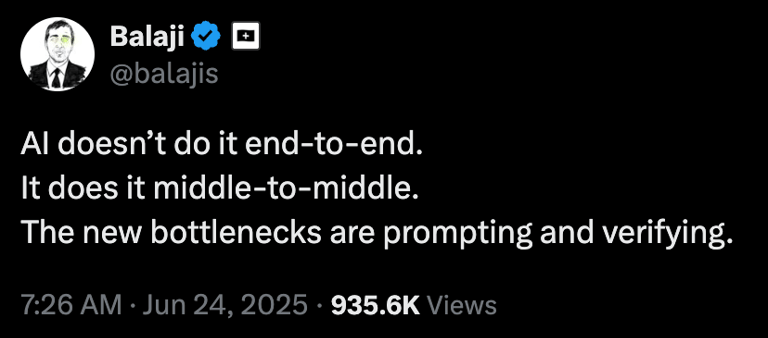
The emerging pattern of AI in HR reveals a critical insight: humans remain essential at both ends of the workflow, while AI excels in middle execution.
X post from @balajis (June 24, 2025)
Consider resume screening:
Human (beginning): Defines role requirements, crafts search parameters, writes prompts capturing nuanced needs ("collaborative but independent," "startup mentality")
AI (middle): Processes 10,000 resumes, applies matching algorithms, generates ranked shortlist
Human (end): Reviews AI recommendations, validates against unstated criteria (culture fit, career trajectory coherence), makes final decisions
This pattern repeats across use cases. AI handles volume and speed; humans provide judgment, context, and quality control.
The new bottlenecks aren't where we expected. Organizations rushing into AI often discover:
Prompt engineering becomes critical: Poor prompts = poor AI outputs. HR teams need skills in articulating requirements precisely—a surprisingly difficult translation from intuition to instruction. Example: "Find candidates with leadership potential" means nothing to AI. "Find candidates who managed teams of 3+ people, drove cross-functional initiatives, or led projects with budgets over $100K" gives the AI something actionable.
Verification capacity constrains throughput: If AI screens 5,000 resumes in 10 minutes but takes 2 hours to verify the top 50, you haven't saved 2 hours—you've created a verification bottleneck. One HR leader noted: "Our AI can generate 100 job descriptions in an afternoon. What we can't do is review 100 job descriptions for accuracy, tone, and compliance in an afternoon."
Quality control becomes the rate limiter: Organizations often underestimate the human effort required to validate AI output at scale. Early adopters report needing more skilled reviewers than anticipated, not fewer staff overall.
Implications for workforce planning:
The AI transition won't eliminate HR roles wholesale; it will reshape them toward higher-skill boundary work—the articulation of problems and the verification of solutions. Organizations must invest in:
Training HR professionals in effective AI prompting (a teachable skill requiring practice)
Building quality assurance capacity and protocols (checklists, sampling methods, escalation criteria)
Accepting that middle-stage acceleration doesn't equal end-to-end acceleration until boundaries are optimized
The workforce shift is from executors to orchestrators. HR professionals become conductors of AI automation rather than executors of tasks. This requires different skills—less data entry fluency, more analytical judgment; less rote processing, more strategic thinking.
Practical example: A recruiting coordinator previously spent 80% of time on interview scheduling logistics. With AI handling scheduling, their role evolves to:
Crafting and refining scheduling prompts for different interview types
Monitoring scheduling success rates and candidate feedback
Handling complex exceptions (executive interviews, multi-site coordination)
Training AI on new scheduling scenarios
Analyzing scheduling data to optimize interview processes
The role isn't eliminated—it's elevated to one requiring more judgment and less busywork. But the transition isn't automatic; it requires intentional reskilling and role redefinition.
Reality 2: Enterprise Evolution Beats Revolution
Large-scale organizational change operates on geological time, not technological time. AI capabilities may advance exponentially, but enterprise adoption follows an S-curve measured in years, not months.
While Silicon Valley operates at breakneck speed—shipping AI features daily, iterating in real-time, moving fast and breaking things—these innovations take considerable time to diffuse beyond the tech epicenter. What works in a 500-person startup in San Francisco doesn't automatically translate to a 50,000-person multinational with legacy systems, union agreements, and decades of established processes. The gap between "possible in the lab" and "deployed at scale in enterprises" is measured not in quarters, but in years.
Why enterprise adoption is inherently evolutionary:
Organizational inertia is real and rational:
Existing processes have stakeholders, compliance requirements, embedded knowledge
"Rip and replace" carries risk; "add and integrate" is safer but slower
Budget cycles and approval processes create natural speed limits
Union agreements, works councils, and labor relations add negotiation layers
Human adaptation requires time:
Workforce retraining can't happen overnight (especially for organizations with 10,000+ employees)
Psychological acceptance of AI assistance follows predictable stages: denial → resistance → exploration → commitment
Trust-building with AI systems requires repeated positive experiences (typically 6-12 months)
Generational differences affect adoption speed (digital natives vs. digital immigrants)
Manager comfort with AI recommendations develops through exposure, not training alone
Ecosystem dependencies create synchronization problems:
AI in recruiting requires candidate comfort with chatbots (societal, not organizational)
AI performance management requires manager buy-in across the organization
Cross-functional AI (HR + IT + Finance agents) requires aligned governance spanning silos
Vendor roadmaps don't always align with customer timelines
Integration partners may lag in updating their connections
Regulatory and ethical frameworks lag technology:
AI employment law is still being written (EU AI Act, emerging US state laws)
What's technically possible today may not be legally/ethically acceptable
Organizations must sometimes wait for societal consensus before deploying certain AI use cases
Industry standards are still emerging (what constitutes "explainable AI" in hiring?)
Technical reality:
AI systems require iterative tuning (6-12 months to optimal performance)
Integration complexity often underestimated by 2-3x
Data quality issues only surface after deployment begins
Edge cases and exceptions emerge slowly, requiring ongoing refinement
The practical implication: Plan for 3-5 year transformation horizons, not 12-month "AI transformation" programs.
Organizations attempting "revolutionary" timelines often face:
Change fatigue and organized resistance
Half-baked implementations (technology deployed but not adopted—usage rates <30%)
Governance failures (moved too fast to build proper controls)
Talent exodus (employees uncomfortable with pace of change, especially senior staff)
Budget overruns (3-4x initial estimates common when rushing)
The evolutionary approach wins:
Steady progress that builds confidence and momentum
Time to learn and adjust course based on results
Stakeholder buy-in through demonstrated wins ("show, don't tell")
Sustainable transformation vs. flash-in-pan initiative that fades
Lower risk of catastrophic failure
Think of AI adoption as a marathon, not a sprint. The winner isn't determined at mile 3; it's determined by who built the endurance to maintain pace through mile 26.
These two realities converge on a single strategic principle:
Success in AI adoption comes from patient, strategic investment in capability building rather than rushed deployment chasing headlines. The organizations that will lead in 2030 aren't necessarily those moving fastest today—they're those building the foundational capabilities (data quality, governance frameworks, AI-literate workforce, adaptive culture) to sustain AI integration over the long term.
The Efficiency Paradox: Why AI Creates More Work Than It Eliminates
One of the most persistent anxieties about AI is job displacement. Will AI eliminate HR roles? The answer is both simpler and more complex than either extreme suggests. History and economics offer a powerful lens: Jevons Paradox and the pattern of efficiency-driven demand expansion.
Jevons Paradox: When Efficiency Increases Consumption
In 1865, economist William Stanley Jevons observed something counterintuitive about James Watt's steam engine. Watt's innovation made coal burning dramatically more efficient—you could get more work from less coal. The logical prediction: Britain's coal consumption should decrease.
The opposite happened. Coal consumption exploded.
Why? More efficient use made coal economically viable for thousands of new applications that were previously too expensive. Efficiency didn't reduce demand—it revealed massive latent demand that had been suppressed by cost and friction.
This pattern—efficiency driving increased consumption rather than decreased demand—repeats throughout economic history:
1960s Containerization: Malcolm McLean's shipping container made cargo transport 90% cheaper. Prediction: massive reduction in dock workers. Reality: Created the modern global supply chain industry. Longshoremen became logistics coordinators managing vastly more complex operations. Global trade exploded; logistics employment grew.
1970s ATMs: Banks expected automated teller machines to replace human tellers. Reality: Cheaper branch operations led banks to open more branches. Tellers shifted from cash handling to relationship management and complex transactions. Bank employment increased.
1990s Spreadsheets: VisiCalc and Excel made financial analysis 100x faster. Prediction: accounting/finance job losses. Reality: Every business unit could now afford analysts. Finance function expanded, became more strategic. Financial analysis became ubiquitous rather than rare.
2000s Cloud Computing: Made infrastructure 10x cheaper than on-premise servers. Prediction: IT layoffs. Reality: IT spending increased exponentially. Created entirely new roles (DevOps engineers, cloud architects, SRE). Organizations that could only afford 2 servers now run thousands of microservices.
2020s AI Inference: Lower costs for running AI models. Prediction: reduced compute demand. Reality: GPU demand at all-time highs (Nvidia stock up 10x). Every company now wants AI infrastructure that was previously unaffordable.
The pattern is clear: Technology that makes work cheaper/faster doesn't eliminate demand—it shifts the bottleneck and reveals latent needs.
The Radiologist Paradox: A Modern Case Study
In 2016, Geoffrey Hinton (the "godfather of deep learning") made a confident prediction: "It's quite obvious that we should stop training radiologists. It's just completely obvious that within five years, deep learning is going to do better than radiologists."
Nearly 10 years later, the AI apocalypse for radiologists hasn't arrived. Instead:
Dozens of FDA-approved AI tools exist that can detect diseases faster and more accurately than humans
Radiologist demand is at all-time highs with persistent shortages
Radiologist salaries have increased, not decreased
Medical imaging as a field has grown substantially in scope and volume
What happened? AI didn't replace radiologists—it transformed the bottleneck.
The pre-AI bottleneck appeared to be: "Reading films is slow and expensive, limiting how many scans we can do."
AI removed that bottleneck, revealing the real constraint: "Expert interpretation, clinical contextualization, and decision-making are what patients need—and there's infinite demand for better diagnosis."
Cheaper, faster AI-assisted scans revealed massive latent demand:
Scans that were previously too expensive → now routine preventive care
Conditions that went undiagnosed → now caught early
Patients who couldn't access imaging → now served
Complex multi-modal analyses → now feasible
Radiologists didn't become obsolete. They evolved:
From "looking at films" → "interpreting complex cases, consulting with physicians, managing AI outputs"
From technicians → medical decision-makers
From bottleneck → high-value strategic resource
The work became more interesting, not eliminated. And demand increased, not decreased.
Jevons Paradox in HR: Efficiency Reveals Hidden Demand
The exact same dynamic is emerging in HR. Let's examine concrete examples:
Resume Screening
Pre-AI baseline:
Recruiter manually screens 50-100 resumes per day
Takes 2-3 weeks to fill a requisition
Can only afford to post for critical roles (opportunity cost too high for other positions)
Many good candidates missed due to volume constraints
With AI screening:
AI processes 5,000 resumes in minutes
Recruiter reviews AI-shortlisted top 50 candidates in 1 hour
Can fill requisition in 3-5 days instead of 3 weeks
Predicted outcome: Need fewer recruiters.
Actual outcome:
Companies hire faster, enabling them to pursue growth opportunities previously constrained by hiring speed
Roles that were left unfilled (couldn't find candidates fast enough) now get filled
Organizations expand hiring for positions that were previously "too hard to recruit for"
Recruiters shift focus to relationship building, employer branding, candidate experience
Latent demand revealed: "We always needed to hire faster—we just couldn't"
HR Helpdesk
Pre-AI baseline:
HR team handles 100-200 inquiries per day
24-48 hour response time for most questions
Employees often don't bother asking questions because response is slow
HR spends 70% of time on repetitive questions
With AI chatbot:
Handles 1,000+ inquiries per day instantly
24/7 availability, zero wait time
Consistent, accurate policy interpretation
Predicted outcome: Eliminate Tier-1 HR support staff.
Actual outcome:
Employees ask questions they never would have bothered with before
"What's the policy on X?" "Can you explain Y?" "How do I do Z?"
Service utilization increases 5-10x (not a typo—employees had hundreds of suppressed questions)
HR team shifts from answering basic questions → complex employee relations, strategic initiatives, personalized support
Latent demand revealed: "Employees had massive unmet information needs that we didn't even know existed"
Learning & Development
Pre-AI baseline:
L&D team creates 10-15 training courses per year
Takes 3-4 months per course (instructional design, content creation, review)
Can only afford generic training (sales basics, leadership 101)
No capacity for role-specific or just-in-time training
With AI content generation:
Can create 100+ courses per year
Course development time: 3-4 days instead of months
Can now create hyper-specific content (negotiation tactics for SaaS sales to healthcare, leadership for first-time managers in remote teams)
Predicted outcome: Reduce L&D headcount.
Actual outcome:
Organizations launch training programs they never had capacity for
Micro-learning, role-specific training, just-in-time content, personalized development paths
L&D team shifts from "course creators" → "learning experience designers, curators, quality controllers"
Training consumption increases 3-5x (employees actually engage when content is relevant)
Latent demand revealed: "Employees always wanted personalized development—we just couldn't deliver it"
People Analytics
Pre-AI baseline:
HR analyst runs 20-30 standard reports per month
Ad-hoc analysis takes days/weeks
Insights limited to what analyst has bandwidth to investigate
With AI dashboards and analysis:
Auto-generates 200+ insights monthly
Ad-hoc questions answered in minutes
Predictive models surface patterns humans would miss
Predicted outcome: Need fewer analysts.
Actual outcome:
More insights → more strategic questions → more intervention opportunities
"Now that we know attrition risk by team, we need retention programs..."
"These engagement patterns suggest we should redesign onboarding..."
"These skill gap analyses reveal strategic workforce planning needs..."
Analyst becomes strategic advisor managing an insights pipeline, not report generator
Latent demand revealed: "Leaders always wanted data-driven decision making—we just couldn't provide enough insights"
The pattern repeats: AI optimizes for speed and scale, while humans provide quality through taste, insight, and intuition. AI handles the volume bottleneck, revealing that the real constraint isn't "how fast can we process this?" but "how good should this be?" Human judgment determines what's worth doing, contextualization shapes how to do it right, and relationship-building ensures it actually works. The latent demand isn't for more speed—it's for better talent decisions, more personalized employee experiences, and strategic workforce planning that only human insight can deliver.
The Hidden Opportunity: Technical Debt Refactoring for the AI Era
Here's where most analyses miss the forest for the trees: The transition to AI-native operations requires massive infrastructure refactoring—creating substantial new work, not eliminating it.
Consider a typical HR policy document: Today, it's a 40-page PDF with tables, formatting, headers, and legal language—designed for a human to read and interpret. An AI agent trying to answer "What's our parental leave policy?" struggles to extract the structured information buried in that format.
In the agentic future, that same policy needs dual-optimization: Still human-readable, but also machine-parseable. Converted to structured markdown:
# Parental Leave Policy
## Eligibility Criteria
- Full-time employees with 12+ months tenure
- Applies to birth, adoption, or foster placement
## Duration
Primary caregiver: 16 weeks paid leave
Secondary caregiver: 6 weeks paid leave
## Approval Process
1. Notify manager 30 days in advance
2. Submit request in Workday
3. HR approval within 5 business days
This structured format uses markdown conventions (# for headers, bold, - for lists, numbered steps) that both humans can read easily AND AI agents can reliably parse and act upon.
This pattern repeats across every artifact: Process flow diagrams → structured markdown workflows. PowerPoint training → markdown documentation with clear headers and lists. Knowledge base articles → consistently formatted markdown with proper hierarchy. Organizations face years of work converting human-optimized documentation into formats that serve both humans and AI agents.
Consider the current state of most enterprise HR systems:
Documentation chaos:
Critical policies buried in PDFs that AI can't effectively parse
Employee handbook in Word docs from 2015 with inconsistent formatting
Knowledge scattered across SharePoint sites, wikis, email threads, Google Docs
No standardized taxonomy or metadata structure
Legacy content in formats AI can't process (old Flash e-learning, scanned documents)
Data inconsistency:
Job titles differ across business units and acquisitions (37 variations of "Project Manager")
Historical employee data in incompatible formats across systems
Skills and competencies not mapped to standardized ontologies
No unified employee/candidate identifiers across ATS/HRIS/learning platforms
Address formats, date formats, organizational hierarchies—all inconsistent
Process ambiguity:
"How we really do things" exists as tribal knowledge, not documentation
Exception handling is "ask Susan, she'll know"
Decision trees aren't codified for AI to follow
Approval workflows differ by region/manager/situation with no clear logic
Legacy systems:
Training content in proprietary formats (Articulate, Captivate) without API access
Videos without transcripts (AI can't search or summarize)
Point-to-point integrations instead of API architecture
To make AI agents effective, organizations must refactor:
Documentation Rewriting
Convert 10+ years of HR documentation into AI-readable formats:
Rewrite policies from PDF → structured markdown with metadata tags
Create FAQ corpuses from years of employee questions
Build knowledge graphs connecting related policies/procedures
Standardize formatting so AI can reliably extract information
Add semantic markup (this is a deadline, this is a requirement, this is an exception)
Data Standardization
Harmonize decades of inconsistent data:
Map all historical job titles to standardized taxonomy
Build skills ontologies and retroactively tag employee records
Clean and validate addresses, employment dates, manager hierarchies
Create unified identifiers across all systems
Implement data quality rules and ongoing monitoring
Process Codification
Document and formalize how work really happens:
Map decision trees for common HR processes
Codify exception-handling procedures for AI escalation
Create runbooks for AI agent operations
Define when human judgment is required vs. AI automation acceptable
Build approval matrices and business rules
Content Migration
Update legacy training and knowledge materials:
Transcribe thousands of hours of training videos
Convert old e-learning to modern, mobile-responsive formats
Rebuild knowledge bases with proper taxonomy and search optimization
Tag and categorize years of institutional content
Archive obsolete materials, update outdated content
Integration Architecture
Build the plumbing for AI systems to communicate:
Develop APIs between systems never designed to integrate
Create data pipelines for real-time AI agent access
Implement observability and monitoring for AI operations
Build authentication/authorization frameworks for AI agents
Establish data governance and security protocols
Why Both Extremes Are Wrong
The "AI apocalypse" camp predicts mass unemployment as AI replaces knowledge workers.
Why this is wrong:
Ignores Jevons Paradox and revealed demand
Underestimates infinite latent need for human judgment, creativity, relationship-building
Misses the technical debt refactoring work required (which creates jobs)
Overlooks that bottlenecks shift rather than disappear
Forgets that every previous "job-killing" technology ultimately created more jobs
The "nothing will change" camp dismisses AI as just another incremental tool.
Why this is wrong:
Underestimates the magnitude of transformation
The shift from execution to supervision/strategy is profound
Skill requirements change radically
Some roles genuinely disappear
Organizations that don't adapt will lose competitive advantage
The nuanced reality:
AI will transform work as profoundly as electrification or computerization did—but these prior transformations didn't cause permanent mass unemployment. They shifted the nature of work.
For HR specifically:
Some roles disappear (pure transactional coordination)
Most roles transform (become supervisory and strategic):
Recruiting Coordinator → Talent Pipeline Architect
HR Generalist → Employee Experience Designer
HRIS Administrator → HR Systems Architect
Learning Coordinator → Learning Ecosystem Manager
New roles emerge (AI operations, governance, prompt engineering)
Latent demand surfaces (personalization, predictive intervention, real-time insights)
Technical debt creates transition work (multi-year refactoring projects)
This is not painless—real people will need to reskill or transition. But it's transformation, not elimination.
→ See Appendix A for detailed role transformation examples showing how these principles manifest in recruiting, HR generalist, HRIS, and L&D positions.
Strategic Takeaways for HR Leaders
1. Don't underestimate the transformation. This is a multi-year journey that will fundamentally reshape HR roles, processes, and value proposition. Prepare your team for profound change.
2. But don't panic about elimination. The "AI will eliminate all HR jobs" scenario is implausible given historical patterns and emerging evidence. Roles transform; they rarely disappear entirely.
3. Budget for technical debt refactoring. Plan for 2-3 years of infrastructure cleanup and modernization. Organizations that skip this will struggle to realize AI's value. This work requires dedicated resources—it won't happen "on the side."
4. Reframe displacement as elevation. Communicate to your team that AI removes drudgery, enabling focus on meaningful, strategic work. Most HR professionals will welcome this once they trust the transition is managed fairly.
5. Plan for revealed demand. As AI unlocks new capabilities, stakeholders will expect HR to deliver things that were previously impossible. Build capacity for this expansion rather than planning pure efficiency plays.
6. Invest in transition support. Some roles will be phased out. Provide reskilling programs, career counseling, and transition assistance. Organizations that manage this humanely retain institutional knowledge and goodwill.
7. Watch for the new bottlenecks. As AI removes execution constraints, new bottlenecks emerge (verification capacity, strategic thinking, change management). Staff and skill for these proactively.
8. Think in decades, not quarters: The full transformation will unfold over 10-15 years (like cloud adoption did). Quarter-to-quarter pressures will tempt shortcuts—resist them. Build for sustainable advantage.
Future Outlook: Three Horizons
Near Term (1-2 Years): AI-Augmented HR Standard
What changes:
AI assistants in every major HR workflow (recruiting, service, learning, compensation)
Generative AI routine for content creation (job descriptions, communications, training)
Predictive analytics dashboards standard in HRIS
Integration with collaboration tools (Teams, Slack) brings HR data into daily workflow
HR roles: Still doing the same jobs, but with AI handling grunt work. Recruiters focus on relationship-building, not resume screening. HR analysts interpret AI insights rather than building reports manually.
Technology: Workday customers begin activating Illuminate agents; early custom agent experiments via Flowise
Challenges: Governance policies lag adoption; spotty AI performance requires tuning; change management stretched thin
Mid Term (3-5 Years): Process Reengineering & New Roles
What changes:
Every HR process redesigned assuming AI agents as first-line workers
HR professionals become "agent supervisors"—managing teams of AI bots
New roles emerge: HR AI Analyst, AI Service Delivery Manager
Significant productivity gains (30%+) allow HR to shift focus from admin to strategy
AI agents treated as "digital coworkers" with identities, access rights, performance tracking
HR roles: Less transactional, more strategic. HR shifts to workforce planning, culture-building, coaching, exception handling. Specialized AI governance becomes standard.
Technology: Multi-agent ecosystems (Workday + Microsoft + OpenAI + custom) requiring orchestration; "segment of one" personalization at scale
Challenges:
Job displacement concerns (some transactional roles eliminated)
Skills gap (HR professionals need AI fluency)
Agent sprawl and integration complexity
Regulatory responses (AI transparency laws likely by 2028)
Critical question: Will productivity gains lead to HR headcount reduction or reinvestment in strategic capacity? IBM reduced HR staff but redeployed to other areas[23]—not all organizations will follow suit.
Long Term (5+ Years): Autonomous Operations & Human-AI Symbiosis
What's possible:
Near-fully autonomous routine HR transactions (payroll, benefits, onboarding)
Personal AI coach for every employee (career guidance, wellness support, performance prep)
Fluid org structures enabled by AI (rapid workforce reconfiguration)
AI agents formally counted in workforce planning
HR becomes guardian of "human element" in increasingly digital workplace
HR roles: Strategic advisors, culture stewards, AI ethicists, change agents. Administrative HR largely automated.
Technology: Highly integrated AI platforms; potentially new regulations require certified AI systems; continuous learning loops between human and AI
Wild cards:
Regulatory environment (could accelerate or constrain)
Societal acceptance of AI in employment decisions
Technical breakthroughs or limitations
Economic factors (recession could slow investment)
Risks:
Over-reliance on AI erodes human judgment capability
Bias becomes embedded at scale
Privacy backlash forces pullback
Vendor consolidation limits choices
Strategic Recommendations
1. Establish AI Governance Before Scaling
Action: Form cross-functional AI governance committee (HR, IT, Legal, Compliance) to create:
AI usage policies (when AI can/cannot make decisions)
Bias auditing protocols (quarterly reviews minimum)
Data access frameworks (least privilege for AI agents)
Human-in-loop requirements (define approval thresholds)
Incident response plan (what if AI makes bad decision)
Leverage: Workday's Agent System of Record for centralized tracking[8][9]
Don't: Deploy broadly without governance—backlash and risk inevitable
2. Start With High-ROI, Lower-Risk Use Cases
Recommended pilot sequence:
Interview scheduling automation (low risk, clear ROI, minimal change management)
HR chatbot for Tier-1 queries (high volume, measurable impact on service)
AI resume screening (higher impact, requires bias monitoring)
Predictive attrition analytics (strategic value, inform retention efforts)
Success criteria for pilots:
20%+ efficiency improvement
No increase in errors/complaints
Positive user feedback (>70% satisfaction)
Clear governance compliance
Then: Scale successes; pause or kill underperformers
3. Invest in Data Quality First
AI is only as good as its data. Audit and improve:
Job architecture consistency (standardized titles, levels)
Skills data completeness (encourage profile updates)
Integration between ATS, HRIS, learning systems
Data cleansing (duplicate records, outdated info)
Leverage: Workday Skills Cloud and Data Cloud capabilities
4. Build AI Fluency Across HR Team
Training priorities:
All HR: AI basics, how to interpret AI recommendations, when to override
HR analysts: Data literacy, prompt engineering, model evaluation
HRIS team: Workday Build/Flowise, API integration, agent configuration
Leaders: AI strategy, ethics, change management
Workday resources: AI Masterclass, certification programs[24][25]
Don't: Assume HR will "figure it out"—formal upskilling essential
5. Communicate Transparently About AI's Role
To employees:
What AI is being used and why
How AI decisions are made (explainability)
Human oversight mechanisms
Privacy protections
How to escalate concerns
To managers:
AI as decision support, not decision maker
How to review and validate AI recommendations
When AI should be overridden
Messaging: Frame as "AI handles repetitive work so humans can focus on meaningful work"—not "AI is replacing people"
Case studies: Share early wins (faster hiring, better answers) to build confidence
6. Monitor Metrics Rigorously
Define success metrics before deployment:
Efficiency:
Time saved (hours per process)
Cost reduction ($ or FTE equivalent)
Process cycle time (time-to-hire, time-to-resolve)
Quality:
Error rates
Quality-of-hire indicators
Employee/candidate satisfaction
Fairness:
Demographic distribution in AI-influenced decisions
Bias testing results
Appeal/override rates
Adoption:
User engagement with AI tools
Escalation patterns
Feature utilization
Review: Monthly for first 6 months, quarterly thereafter
Conclusion
AI agents represent a genuine inflection point for HR—an opportunity to shift from administrative burden to strategic powerhouse. The technology has matured beyond experimentation; organizations deploying AI in HR today see measurable gains in efficiency, experience, and decision quality.
For Workday customers specifically, the platform's $1B+ AI investment positions it as a comprehensive solution—from conversational recruiting to intelligent learning to enterprise knowledge search. The breadth of capability is impressive; the execution challenge is real.
The path forward requires balance:
Ambition tempered by realism: AI will transform HR, but not overnight
Innovation balanced with responsibility: Move fast, but govern carefully
Technology paired with humanity: AI augments people, doesn't replace the human element of HR
AI is the New Electricity: The Historical Imperative
Dr. Andrew Ng, founder of Google Brain and former Chief Scientist at Baidu, has framed the current moment precisely: "AI is the new electricity." This isn't hyperbole—it's a historically grounded prediction about transformation scale and inevitability.
Consider what electricity did to business in the early 20th century:
1880s-1900: Expensive, unreliable, poorly understood. Most businesses dismissed it as novelty. Early adopters experimented cautiously.
1900-1920: Benefits became undeniable. Infrastructure investment accelerated. Competitive pressure mounted—electrified factories were 30-50% more productive. Workforce gradually learned new skills.
1920-1940: Electricity became expected, not exceptional. Entire industries reorganized around electric power. Businesses without electricity couldn't compete. New business models emerged.
1940-present: Electricity so fundamental it's invisible infrastructure. Competitive advantage no longer from having electricity, but from what you do with it.
The critical insight: Competitive advantage went to those who adopted electricity during the transition period (1900-1930), not those who waited until it was ubiquitous. By 1940, having electricity was table stakes—everyone had it, so it conferred no advantage.
The organizations that dominated the 20th century—Ford, GE, IBM—were those that aggressively electrified in the 1910s-1920s, fundamentally reorganizing operations around this new capability. Those that waited (citing valid concerns about cost, complexity, skill gaps, unproven ROI) found themselves struggling to catch up or going out of business.
We are currently in the early transition phase of AI adoption (analogous to 1900-1920 for electricity):
Where we are now (2024-2025):
AI delivers clear benefits, but implementation is complex
Infrastructure maturing (Workday acquisitions, Microsoft Copilot, agent platforms)
Standards emerging (RAG architectures, governance protocols)
Workforce learning to work alongside AI
Cost declining rapidly (inference costs down 10x in 2 years)
Competitive pressure building: AI-enabled organizations hiring 50%+ faster
Where we're headed (2025-2035):
AI becomes expected in HR systems, not exceptional
Entire HR function reorganizes around AI capabilities
Organizations without AI struggle to compete for talent
New service models emerge (AI-first employee experiences, predictive HR)
"AI fluency" becomes standard HR competency
The strategic window is now. Just as with electricity, competitive advantage goes to organizations that adopt AI during the transition period. By 2035, having AI in HR will be table stakes—everyone will have it, so it will confer no advantage.
What the electricity analogy teaches us:
Transformation is inevitable, not optional. No business remained competitive without electricity by 1940. No HR function will remain competitive without AI by 2035. The question isn't "Should we?" but "How quickly can we adopt it responsibly?"
Infrastructure investment precedes value. Early electricity adopters spent heavily on wiring, equipment, training before seeing ROI. Similarly, AI requires upfront investment in data quality, governance, skills, and technical debt refactoring. This isn't waste—it's foundation.
Resistance stems from legitimate concerns—but delay is costly. Early electricity skeptics worried about fire risk, cost, complexity. Early AI skeptics worry about bias, privacy, displacement. Valid concerns require thoughtful mitigation, not paralysis through delay.
Competitive advantage is temporary. Early electrifiers gained 10-20 year advantages. Early AI adopters will gain similar windows. But the advantage comes from moving during transition, not from the technology itself once ubiquitous.
Reorganization required, not just addition. Factories didn't just add electric motors to steam-powered layouts—they completely redesigned workflows. HR won't just add AI tools—must redesign the entire operating model around AI capabilities.
The earlier you adopt, the more benefits you reap:
Talent competition: AI-enabled recruiting fills roles 50% faster. In tight talent markets, this is decisive. By 2027, top talent will avoid organizations with clunky, slow processes—just as consumers avoid businesses with bad websites.
Productivity arbitrage: As competitors achieve 30-50% productivity improvements through AI, they reinvest savings in strategic initiatives, better compensation, or growth. Organizations without AI face cost disadvantages that compound.
Data advantages compound: AI improves with data. Organizations adopting now accumulate more data, train better models, gain insights competitors lack. This virtuous cycle is hard to overcome once established.
Skills take time: Building AI fluency takes 2-3 years. Starting now means your workforce is AI-capable by 2027. Waiting until 2027 means building capability while competitors already operate AI-natively—a nearly insurmountable disadvantage.
But avoid electrification's mistakes:
Don't rush without preparation (governance, data quality, change management). Don't automate broken processes. Don't ignore workforce concerns. Don't assume one-size-fits-all timelines.
The balanced approach: Aggressive on vision, thoughtful on execution.
Start now building AI capability—don't wait until 2027-2028. Invest in infrastructure before expecting ROI. Pilot aggressively, scale methodically. Reorganize fundamentally around AI capabilities. Manage workforce transition humanely. Build for 5-10 year horizon.
The goal: Be an early mover in the transition period (2025-2028), gaining competitive advantage. Don't be a laggard arriving when AI is table stakes (2032+), finding no advantage and playing catch-up.
For CIOs and CHROs: The competitive window for AI leadership is 2025-2028. Organizations that adopt AI thoughtfully but aggressively in this period will build 5-10 year advantages in talent. Those that delay will face the same fate as businesses that delayed electrification: perpetual catch-up.
The verdict: Lean in strategically with urgency. Pilot aggressively, govern rigorously, invest in infrastructure, scale what works, and keep humans at the center. The future of HR is human-AI collaboration—and that future isn't coming, it's already here.
Just as electricity transformed every business by 1940, AI will transform every HR function by 2035. The question is whether you'll be an early mover who shapes that transformation, or a late follower struggling to catch up.
The pioneers of the electric age became the industrial giants of the 20th century. The pioneers of the AI age will become the talent powerhouses of the 21st. Which will you be?
Appendix A: The Transformation of HR Roles: Concrete Examples
The following examples demonstrate how AI transforms—rather than eliminates—core HR roles. Each profile shows the current state (2024), what AI automates (2028), and how the role evolves to higher-value work. These are composites based on early adopter experiences and projected trends. Actual transformation timelines vary by organization size, industry, and AI maturity.
Recruiting Coordinator → Talent Pipeline Architect
Old job (2024):
Manually schedule 20-30 interviews per week
Send calendar invites, coordinate logistics
Handle interview cancellations and rescheduling
Prepare interview materials
Chase interviewers for feedback
AI handles (2028):
Automated scheduling with AI assistant
Calendar management and logistics
Candidate communication (confirmations, reminders)
Feedback collection prompts
New job (2028):
Design and optimize recruiting workflows
Manage AI agent performance (monitoring success rates, refining prompts)
Handle complex scheduling exceptions (executive interviews, panel coordination)
Analyze recruiting funnel data to identify bottlenecks
Improve candidate experience through process design
Strategic talent pipelining and relationship nurturing
Skill shift: From administrative coordination → process design and data analysis
HR Generalist → Employee Experience Designer
Old job (2024):
Answer 30-40 repetitive policy questions daily
Process routine requests (PTO, benefits changes)
Maintain employee files
Handle basic employee relations issues
Run standard reports
AI handles (2028):
Tier-1/2 inquiries via chatbot (policy questions, how-tos)
Auto-process standard requests
Maintain digital records
Generate standard reports and alerts
New job (2028):
Design personalized employee journeys and touchpoints
Intervene proactively in complex employee relations cases
Conduct skip-level conversations to understand morale and culture
Implement retention initiatives based on AI-surfaced insights
Create programs addressing patterns AI detects
Serve as escalation point for AI-handled cases requiring human judgment
Skill shift: From reactive problem-solving → proactive experience design and relationship building
HRIS Administrator → HR Systems Architect
Old job (2024):
Configure Workday workflows and security
Run reports and exports
Manage user access
Troubleshoot system issues
Train users on system basics
AI handles (2028):
Auto-generate standard reports
Surface insights via dashboards
Detect data anomalies
Basic troubleshooting through chatbot
New job (2028):
Design AI agent workflows and integrations
Architect data structures optimized for AI consumption
Integrate multiple AI systems (Workday + partners)
Ensure governance, security, and compliance
Develop and tune AI prompts for HR use cases
Train organization on AI capabilities
Monitor AI agent performance and ROI
Skill shift: From system administrator → solutions architect and AI strategist
Learning Coordinator → Learning Ecosystem Manager
Old job (2024):
Schedule training sessions and manage logistics
Track completions in LMS
Coordinate instructors and materials
Handle training registrations
Run completion reports
AI handles (2028):
Auto-generate personalized learning paths
Create course content from source materials
Track engagement and send reminders
Recommend learning based on skills/role
Generate completion analytics
New job (2028):
Curate learning experiences across platforms
Ensure AI-generated content quality and relevance
Design skill development strategies aligned to business needs
Manage learning technology ecosystem
Partner with business leaders on capability building
Analyze learning ROI and effectiveness
Identify emerging skill needs and source/create content
Skill shift: From logistics coordinator → strategic learning partner and content curator
Common Patterns Across Role Transformations
AI eliminates repetitive execution, not entire roles
New roles require higher technical fluency (data, systems, AI)
Strategic thinking and relationship skills become MORE valuable
Transition requires 12-24 months of deliberate reskilling
Organizations must invest in transition support and compensation adjustments
Early movers build AI-fluent cultures that compound advantages
Appendix B: Key Resources
Workday AI Resources:
Workday Build Developer Platform: blog.workday.com
AI Trust Framework: investor.workday.com/governance
Community Edition (free sandbox): workday.com/developers
Industry Analysis:
Josh Bersin on AI in HR: joshbersin.com
Aptitude Research: aptituderesearch.com
Reworked (digital workplace): reworked.co
Governance Frameworks:
NIST AI Risk Management Framework
EU AI Act compliance guides
IEEE P7003 (Algorithmic Bias Standard)
Document Metadata:
Version: 3.0 Final
Length: ~16,000 words
Author: InteDao Consulting
Date: October 2025
Target Audience: CIOs, CHROs, HRIS Directors, HR Transformation Leaders
Sources and References
[1] The Crucial Role of AI Agent Testing in Mitigating Enterprise Risk | by AlignX AI | Jul, 2025 | Medium https://medium.com/@AlignX_AI/the-crucial-role-of-ai-agent-testing-in-mitigating-enterprise-risk-6405ad38c546
[2] The Digital Workforce Is Here: Are You Ready to Lead It? | Workday US https://blog.workday.com/en-us/digital-workforce-here-are-ready-to-lead.html
[3] Workday Signs Definitive Agreement to Acquire Paradox, the AI Company Redefining the Frontline Candidate Experience - Aug 21, 2025 https://investor.workday.com/2025-08-21-Workday-Signs-Definitive-Agreement-to-Acquire-Paradox,-the-AI-Company-Redefining-the-Frontline-Candidate-Experience
[4] Workday Acquires Sana To Transform Its Learning Platform And Much More – JOSH BERSIN https://joshbersin.com/2025/09/workday-acquires-sana-to-transform-its-learning-platform-and-much-more/
[5] Workday Signs Definitive Agreement to Acquire Sana - Sep 16, 2025 https://investor.workday.com/2025-09-16-Workday-Signs-Definitive-Agreement-to-Acquire-Sana
[6] AI Agents Are Built for Action (IBM case study) https://www.reworked.co/digital-workplace/meet-your-new-ai-teammates-they-dont-just-chat-they-deliver/
[7] Workday Buys Sana for $1.1B, Announces New AI Capabilities at Workday Rising https://www.reworked.co/digital-workplace/workday-launches-build-platform-for-custom-ai-solutions/
[8] [9] [10] The Digital Workforce Is Here: Are You Ready to Lead It? | Workday US (Agent System of Record) https://blog.workday.com/en-us/digital-workforce-here-are-ready-to-lead.html
[11] Workday Acquires Sana To Transform Its Learning Platform And Much More – JOSH BERSIN (Competitive context) https://joshbersin.com/2025/09/workday-acquires-sana-to-transform-its-learning-platform-and-much-more/
[12] Workday Announces Intent to Acquire HiredScore - Feb 26, 2024 https://investor.workday.com/2024-02-26-Workday-Announces-Intent-to-Acquire-HiredScore
[13] [14] [15] Workday Signs Definitive Agreement to Acquire Paradox - Aug 21, 2025 https://investor.workday.com/2025-08-21-Workday-Signs-Definitive-Agreement-to-Acquire-Paradox,-the-AI-Company-Redefining-the-Frontline-Candidate-Experience
[16] [17] [18] [19] Workday Signs Definitive Agreement to Acquire Sana - Sep 16, 2025 https://investor.workday.com/2025-09-16-Workday-Signs-Definitive-Agreement-to-Acquire-Sana
[20] Introducing Workday Build: The Developer Platform to Build the Future of Work with AI | Workday US https://blog.workday.com/en-us/introducing-workday-build-developer-platform-build-future-work-ai.html
[21] [22] Workday Acquires Flowise, Bringing Powerful AI Agent Builder Capabilities to the Workday Platform - Aug 14, 2025 https://newsroom.workday.com/2025-08-14-Workday-Acquires-Flowise,-Bringing-Powerful-AI-Agent-Builder-Capabilities-to-the-Workday-Platform
[23] AI Agents Are Built for Action (Workforce transition) https://www.reworked.co/digital-workplace/meet-your-new-ai-teammates-they-dont-just-chat-they-deliver/
[24] [25] Introducing Workday Build: The Developer Platform to Build the Future of Work with AI | Workday US (Training resources) https://blog.workday.com/en-us/introducing-workday-build-developer-platform-build-future-work-ai.html